
Mission Statement
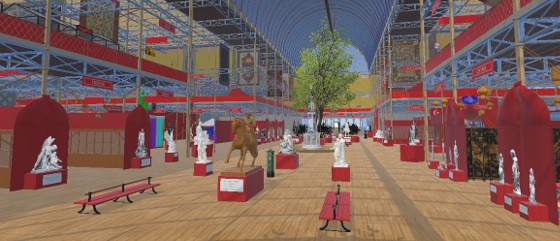
To create a computer simulation of the 1851 Great Exhibition, as accurate and as complete as possible, said simulation will always be free-of-charge to the user. It is accepted that this is a multi-year project.
Platform
The principal platform for the simulation is fully immersive Virtual Reality (i.e. the user wears a VR headset). Initially this is via SteamVR. If no VR headset is available, the SteamVR version falls back to desktop mode (monitor / keyboard / mouse). Other platforms are under consideration and will be added as and when possible.
Accuracy
Extensive use is made of contemporary publications such as: engineering drawings; floor plans; maps; illustrations (photographs, watercolours, engravings, etc.); the exhibition catalogues, newspapers, periodicals & books (providing both illustrations and written descriptions). These sources are used to reproduce the Crystal Palace building, boiler house, railings, etc.; and the contents & environs of the exhibition (exhibits plus fixtures & fittings).
In many cases models of items can confidently be placed in exactly the position occupied at the Great Exhibition. In other cases the location of items can be narrowed down to a general area, but there is insufficient information to place them exactly. Some items moved in the 5½ months during which the exhibition was open, other items were added part way through – in these cases the simulation places items in their last known position.
Some items are identified only by name in contemporary documentation, but by being well-known more recent illustrations (or the extant item itself) can be identified. This most obviously relates to artworks (particularly sculpture). In some cases the original exhibit does not survive but an alternate (virtually identical) version survives – in such cases the surviving version is modelled as an alternate.
Extant exhibits
Many exhibits survive: in museum collections (e.g. the Science Museum Group; the Victoria & Albert Museum), educational establishments (e.g. University College Oxford; University College London; Eton College), public buildings (e.g. Palace of Westminster; Battersea Arts Centre), places of Worship (e.g. Westminster Abbey; Canterbury Cathedral), and in private collections. Extant exhibits are to be found all over the world: the most distant so far located is in Taupō Museum New Zealand. Wherever possible, these extant exhibits are scanned to create 3D models. Where scanning is not possible, photographs of the extant items are used as a reference to create reproductions.
Internationalisation
Currently the simulation is available in English and Polish. The structure of the project allows other languages to be added as and when translations become available.
Third party contributions
The project relies on third party contributions: whether as existing artefacts (images, 3D models, etc.) which we have been allowed to use; access to extant exhibits to allow us to photograph them; sponsorship to finance the creation of 3D models; help in locating extant exhibits; direct practical and technical assistance. Please follow this link to see how you can help.


